
History of the Schwaben People
The 15th and 16th centuries witnessed the creation of the powerful Ottoman Empire. It conquered not only all the Balkan States and most of Hungary, but even beleaguered the City of Vienna in the next century. Those fierce forces controlled Southeastern Europe for more than 150 years and ravaged the land and scattered the people during this time so badly that some areas lost all traces of civilization.
When the Turks of the Ottoman Empire were finally defeated with the help of Baden’s Prince Eugen, it was the primary goal of Prince Eugen to colonize the land again and to make it fruitful. Emperor Charles IV, the Empress Maria Theresa, and Emperor Joseph II encouraged settlers, farmers and craftsmen primarily from West German lands to settle in the now ravaged land. They traveled not with wagon trains westward, but with barges eastward on the Danube River to reach their new homes. They settled on the potentially fertile land along that river as well as some of its tributaries and, hence, they were called the Danube Swabians.
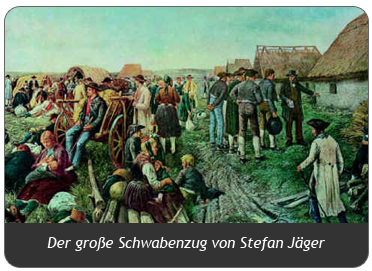
Many of the settlers never saw the fruits of their labours because of the famine and plague that swept through their ranks. The pioneer spirit prevailed however, and they not only re-established a civilization, but in the span of 200 years made this area one of the most fruitful in Southeastern Europe. It was even referred to as the “Breadbasket of Europe”.
The Danube Swabians were extremely proud of their German language and cultural heritage, and lived in closely-knit settlements to maintain it. The number of settlers increased to such an extent that land became scarce and – that pioneering spirit still strong – many came to America at the end of the 19th century. Upon the conclusion of the First World War, when the Austro-Hungarian Monarchy was dissolved and this area was parceled up among Hungary, Rumanian and Yugoslavia; many more came to Canada as well.
A major tragedy of the Second World War was the annihilation of approximately 250,000 Danube Swabians in the concentration camps of Tito. Furthermore, 100,000 of our people from Romania and Hungary were abducted to Russia and the Baragan steppes of Romania for forced labour. Many thousands perished. The largest part of the surviving Danube Swabians were forced to flee or were expelled from their homeland as a result of the ever advancing communism. Most of them sought refuge in the already overcrowded countries of Germany and Austria, where some of them still remain.
For many Danube Swabians, the liberal immigration laws of Canada gave renewed hope and the opportunity to start anew – as their forefathers had done again and again. A large number settled in Southwestern Ontario, near Regina, Saskatchewan, and in British Columbia. Their diligence, honesty, and prudence gained them the respect of not only the other immigrants, but also of the Canadian public in general. They adapted quickly to the ways of their new home and many played a substantial role economically and politically. They are industrious workers, prudent investors, faithful and loyal citizens of Canada, but they never lost their pride in their heritage or their regard for moral values as when they were inculcated along the Danube River.
The Danube Swabians created organizations and associations such as ours [the Schwaben Club of Kitchener] to assist each other in time of sickness or need. They also supported German language schools, youth and sport groups, folk dancing groups, choirs, etc. All of this in the hopes of preserving their language, songs, dances and customs.
Should you be interested in more information regarding Swabian history and peoples, please visit:
Wikipedia: en.wikipedia.org/wiki/Danube_Swabians
Genealogie Netz: www.genealogienetz.de/reg/ESE/dschwaben.html
Danube Swabian Resources: www.danube-swabians.org